

Why Probate Solicitors Register With Tracing Direct – Ready When You Need Us
Probate matters do not always go according to plan.
An estate may appear straightforward until a beneficiary cannot be located. A family tree may contain an unexplained gap. An intestacy case may reveal relatives nobody knew existed. Or a beneficiary believed to be living in the UK may turn out to have moved overseas decades ago.
When that happens, probate solicitors need access to specialist research support — and often they need it quickly.
That is why we invite solicitors and legal professionals to register with Tracing Direct, even if you don't currently have a case requiring our assistance.
There is no need to wait until a difficult probate matter lands on your desk.
By registering your firm with us now, Tracing Direct will already be there when you need specialist beneficiary tracing or probate research support in the future.
You may not need us today. But when you do, we'll be ready to help.
What Does Tracing Direct Do?
Tracing Direct provides professional beneficiary tracing and probate research services to solicitors, executors and other professionals involved in estate administration.
Our work can include:
Locating a named beneficiary in a Will
Tracing missing beneficiaries
Probate and genealogical research
Family tree research and verification
Intestacy investigations
Locating potential heirs
UK beneficiary searches
International beneficiary tracing
Some instructions involve finding one named person. Others require a much broader investigation to establish a family tree, identify those potentially entitled and then locate them.
Whatever the circumstances, our role is to provide the specialist research support required to help move the matter forward.
Why Should a Solicitor Register Before They Need Us?
It is easy to put specialist suppliers to one side until a case actually requires their services.
But probate problems can arise unexpectedly.
You may suddenly discover that the address in a Will is 25 years old. An executor may tell you they have lost contact with a relative. An intestacy matter may require an entire branch of a family to be established.
At that point, you don't necessarily want to start looking for a probate researcher from scratch.
Registering with Tracing Direct means you have already established that connection.
When a suitable matter arises, you know who to contact.
Registration Does Not Mean You Have to Instruct Us
This is important.
Registering with Tracing Direct does not mean you are committing to instructing us or agreeing to send us a particular volume of work.
You may register and not require our services for months.
That's absolutely fine.
The purpose is simply to establish the relationship so that, should you encounter a probate matter requiring specialist research, you already know Tracing Direct and can approach us for assistance.
Think of us as an additional specialist resource available to your probate or private client team when required.
Helping Probate Teams React Quickly
Speed can matter when a missing beneficiary is preventing an estate from progressing.
If your team has already spent valuable time attempting to locate someone internally, further delays may be frustrating for both the solicitor and the executor.
Having access to a professional tracing service means the research element can be passed to people who specialise in locating individuals and investigating family relationships.
Registering in advance means that when the need arises, you can come directly to Tracing Direct and discuss the instruction.
Locating a Named Beneficiary in a Will
One of the most common situations is also one of the simplest to explain.
A Will names a beneficiary, but nobody knows where that person is now.
Perhaps the Will was written 20 or 30 years ago.
The beneficiary may have moved several times, married and changed their surname, emigrated or simply lost contact with the deceased.
Tracing Direct can undertake research aimed at establishing the beneficiary's current whereabouts and verifying that the individual located is the correct person.
Intestacy and Family Tree Research
The second common type of instruction is considerably broader.
Where someone dies without leaving a valid Will, solicitors may need assistance establishing the deceased's family tree and identifying potential beneficiaries.
This can involve research across several generations and different branches of a family.
Once potential beneficiaries have been identified, some may then need to be located.
Tracing Direct can assist with both elements: establishing the family structure and tracing the people identified through that research.
UK and International Beneficiary Tracing
Families rarely remain in one place for generations.
A probate investigation beginning in Cardiff or elsewhere in the UK may ultimately lead to Australia, Canada, the United States, New Zealand, Europe or further afield.
Our research can follow those family connections wherever the available evidence leads.
This means solicitors have one research contact whether the beneficiary is believed to be around the corner or on the other side of the world.
Supporting Solicitors, Not Replacing Their Role
Tracing Direct's role is to provide specialist research support.
The solicitor remains responsible for the legal administration of the estate and for determining matters of legal entitlement.
We focus on what we do best: researching family relationships and locating people.
This distinction allows probate professionals to use specialist external support when required while continuing to manage the legal aspects of the estate for their clients.
A Reliable Probate Research Partner
When a solicitor instructs an external researcher, reliability matters.
You need clear communication, professional handling of the instruction and confidence that research is being approached properly.
At Tracing Direct, our service is built around:
Professionalism — dealing appropriately with solicitors, executors and beneficiaries.
Reliability — providing a service legal professionals can depend upon.
Responsiveness — understanding that probate matters sometimes require research to begin quickly.
Clear communication — keeping instructing professionals informed.
Discretion — handling sensitive family and estate matters appropriately.
Competitive pricing — providing professional research at a sensible cost.
Our objective is to make instructing Tracing Direct straightforward for busy probate teams.
Why Build the Relationship Now?
Hopefully, your next probate instruction will be completely straightforward.
Every beneficiary will be known. Every address will be current. The family structure will be clear.
But eventually, a case may arrive where that isn't the situation.
That is when having a trusted research contact already available becomes valuable.
You shouldn't need to start searching for a beneficiary tracing company when you are already dealing with a difficult estate.
Register now, and Tracing Direct will be there when you need us.
Register Your Firm With Tracing Direct
If you are a probate solicitor, private client solicitor or legal professional involved in estate administration, we invite you to register with Tracing Direct.
You don't need to have a current instruction.
There is no obligation to send us a case simply because you register.
Instead, registration means you can establish a connection with Tracing Direct now, so when a future probate matter requires beneficiary tracing, family tree research, intestacy investigation or international probate research, you know where to turn.
Even if you don't need us today, you may need us tomorrow.
Professional probate research support — ready when you need it.
Tracing Beneficiaries Overseas: A Guide for Probate Solicitors
Administering an estate can become considerably more complicated when a beneficiary is believed to be living overseas.
Perhaps a relative emigrated decades ago. Their last known address may no longer exist. They may have married and changed their surname, moved between countries or died leaving descendants who now need to be identified.
For probate solicitors and executors, these situations can turn what initially appears to be a straightforward estate into a complex international investigation.
Professional international beneficiary tracing can help establish where beneficiaries are now, verify their identity and provide the information required to move estate administration forward.
Why Do Beneficiary Searches Become International?
Families are more geographically dispersed than ever.
Someone who grew up in Cardiff, London or elsewhere in the UK may have emigrated to Australia, Canada, New Zealand, the United States, Europe or further afield many years ago.
Their children and grandchildren may subsequently have been born overseas.
This means an estate being administered in the UK can involve beneficiaries located anywhere in the world.
Common scenarios include:
A beneficiary emigrated many years ago
The family lost contact after the person moved abroad
Only an old overseas address is available
The beneficiary changed their surname
The individual moved between several countries
The beneficiary may have died overseas
Their descendants need to be identified
An intestacy investigation uncovers an overseas branch of the family
Each situation can require a different research approach.
Why Is Overseas Beneficiary Tracing More Complicated?
Tracing someone internationally can involve challenges that do not necessarily arise during a straightforward UK search.
Different countries maintain different public records.
The information available to researchers can vary significantly between jurisdictions, as can naming conventions, address formats and record-keeping practices.
Language can also become a factor.
An individual may additionally have moved several times since leaving the UK, meaning researchers first need to establish the route they took before attempting to identify their current whereabouts.
Successful international tracing therefore often involves combining historical family research with contemporary investigative work.
What Information Helps an International Beneficiary Search?
Even relatively old information can provide a useful starting point.
Helpful details may include:
Full name
Previous or maiden names
Date or approximate year of birth
Last known UK address
Last known overseas address
Country of emigration
Approximate year of emigration
Names of parents or siblings
Marriage information
Occupation
Names of children
Previous correspondence
Known family connections
It is not essential to have all this information before an investigation begins.
Professional researchers can assess what is already known and determine which lines of enquiry are most appropriate.
Following the Evidence Across Borders
An international beneficiary investigation rarely consists of searching one overseas database.
Instead, researchers may need to reconstruct part of the individual's life.
For example, records might establish that a person left South Wales for Australia several decades ago.
Further research may then identify a marriage, a change of surname, children or a later move to another region.
Each discovery provides another piece of the investigation.
The objective is to build a reliable chain connecting the person originally identified in the estate research with the individual ultimately located.
What if the Beneficiary Has Changed Their Name?
Name changes are a common challenge in beneficiary tracing.
Marriage is an obvious example, particularly where researchers are tracing someone from information that is several decades old.
However, there may be other reasons why someone's present identity differs from the name originally provided.
This makes documentary research particularly important.
Simply locating somebody with a similar name in the correct country is not sufficient.
Researchers need confidence that the person identified is genuinely connected to the family and estate being investigated.
What if the Overseas Beneficiary Has Died?
Discovering that a missing beneficiary has died does not necessarily conclude the research.
Depending upon the circumstances of the estate and the legal position, further investigation may be required.
Researchers might need to establish when and where the person died or identify further family members.
For probate solicitors, this can transform a single-person trace into a wider genealogical investigation.
Appropriate legal advice will determine what effect the beneficiary's death has on the estate, while professional probate research can help establish the relevant facts and family relationships.
International Tracing and Intestacy
Overseas research can become particularly important where somebody dies without leaving a valid Will.
Under the Rules of Intestacy, identifying those who may be entitled to inherit can require research across multiple branches and generations of a family.
If one branch emigrated many years ago, researchers may need to follow that family overseas.
Children and grandchildren may have been born outside the UK and may have no knowledge of their connection to the deceased.
This is why family tree verification and beneficiary tracing often work together during complex intestacy investigations.
First, the relevant family structure needs to be established.
Then the individuals identified through that research may need to be located.
Can Someone Inherit From a UK Estate if They Live Overseas?
Living outside the UK does not, by itself, mean that an otherwise entitled beneficiary cannot benefit from an estate.
However, international estates and distributions can involve legal, tax, identification and administrative considerations.
Those matters should be handled by the solicitor or other professional administering the estate.
The role of a tracing company is different: to help establish who and where the relevant person is and provide appropriate research findings.
Why Identity Verification Matters
Finding a potential beneficiary is only part of the job.
Consider a researcher looking for somebody called David Jones who emigrated from Wales several decades ago.
Finding a David Jones of approximately the correct age in Australia would clearly not provide sufficient confidence that the correct person had been located.
Dates of birth, previous addresses, family relationships and other information may need to be cross-referenced.
Accuracy is essential because the consequences of identifying the wrong person in connection with an estate can be significant.
How Long Does International Beneficiary Tracing Take?
There is no universal timescale.
Some international searches may progress relatively quickly where good information and accessible records are available.
Others can take considerably longer.
Factors affecting the investigation include:
The country involved
How long ago the person emigrated
Quality of the starting information
Name changes
Multiple international moves
Availability of appropriate records
Whether the beneficiary is still living
Whether additional generations need investigating
For this reason, solicitors should be cautious about any tracing provider offering unrealistic guarantees without first understanding the case. See more regarding How Long Does It Take To Trace A Missing Beneficiary?
Why Probate Solicitors Should Start Overseas Searches Early
If there is evidence that a beneficiary lives overseas, addressing the issue early can help prevent delays later.
Waiting until an estate is otherwise ready for distribution before beginning an international search may create an avoidable bottleneck.
Instead, tracing work can often proceed alongside other aspects of estate administration.
Early instruction also gives researchers the opportunity to investigate unexpected complications without unnecessary pressure being placed on the wider probate process.
Professional International Probate Research
For solicitors, outsourcing specialist overseas research can also reduce the amount of fee-earner time spent attempting to navigate unfamiliar record systems.
A professional probate researcher can concentrate on the investigative work while the solicitor continues dealing with the legal administration of the estate.
This separation of roles can be particularly valuable where an apparently simple search develops into a multi-generational or multi-jurisdictional investigation.
How Tracing Direct Can Help
At Tracing Direct, we undertake beneficiary tracing and probate research for solicitors, executors and other professional clients.
Our services include:
UK beneficiary tracing
International beneficiary tracing
Missing beneficiary searches
Family tree verification
Probate research
Intestacy research
Heir tracing
People tracing
An investigation may begin with an old address in Cardiff or elsewhere in the UK and ultimately lead to another part of the world.
Our role is to follow the evidence wherever the investigation takes us.
A Professional, Reliable and Discreet Service
Probate solicitors need confidence in the researchers they instruct.
At Tracing Direct, our approach centres on professionalism, reliability, discretion, accuracy and clear communication.
We also understand the importance of cost and aim to provide competitively priced research appropriate to the individual circumstances of each case.
Whether the instruction involves locating one overseas beneficiary or investigating an entire branch of a family, every case is approached individually.
Need to Trace a Beneficiary Overseas?
If you are administering an estate involving a beneficiary believed to be living outside the UK, Tracing Direct can help.
You do not necessarily need a current address or complete family history before contacting us.
Provide the information you already have and our researchers can assess the case and determine an appropriate way forward.
Contact Tracing Direct today to discuss your UK or international beneficiary tracing requirements.
How Long Does It Take to Trace a Missing Beneficiary?
When a beneficiary cannot be located during the administration of an estate, one of the first questions solicitors and executors understandably ask is:
How long will it take to find them?
There is no single answer.
Some beneficiaries can potentially be located relatively quickly. Others require extensive family-tree research, historical records, overseas enquiries or investigation across several generations.
The time required for beneficiary tracing depends largely upon the information available at the beginning of the investigation and the complexity of the individual case.
Understanding what can affect a beneficiary search—and starting that search early—can help reduce unnecessary delays during probate.
Why Do Beneficiaries Need to Be Traced?
A beneficiary may be named in a Will, but the contact information available could be many years out of date.
Alternatively, the beneficiary may first need to be identified through probate or family-tree research.
Common situations include:
A beneficiary has moved from their last known address
Family members have lost contact
A surname has changed
The beneficiary has emigrated
The individual has little obvious online presence
The beneficiary may have died
The deceased's family tree is incomplete
An intestate estate requires relatives to be identified
Potential beneficiaries live overseas
The circumstances surrounding the individual will influence how straightforward—or complicated—the search becomes.
Can a Missing Beneficiary Be Found Quickly?
In some cases, yes.
Where researchers have a full name, date of birth, relatively recent address and reliable family information, there may be strong starting points for an investigation.
However, it would be misleading for any professional tracing company to guarantee that every beneficiary can be located within a particular number of days.
Every investigation is different.
A search involving somebody who moved from Cardiff to another part of the UK several years ago may require a very different research strategy from locating someone whose family emigrated to Australia several decades ago.
The important factor is having an appropriate research strategy from the outset.
What Information Helps a Beneficiary Search?
The quality of the information available at the beginning can make a significant difference.
Useful information may include:
Full name
Previous names
Approximate or confirmed date of birth
Last known address
Previous addresses
Names of parents or siblings
Marriage information
Occupation
Known geographical connections
Details of relatives
Possible overseas connections
Not every piece of information needs to be available before an investigation can begin.
Even limited information can sometimes provide the starting point for further research.
What Can Make Beneficiary Tracing Take Longer?
Several factors can increase the complexity of an investigation.
1. Very Common Names
Locating the correct John Williams or Sarah Jones can be considerably more challenging than tracing someone with an unusual combination of names.
Researchers must ensure that the individual located is actually the correct person rather than simply someone with a similar identity.
2. Old or Incomplete Information
A last known address from 30 or 40 years ago can still be useful, but considerably more research may be required to connect historical information with a person's current circumstances.
3. Name Changes
Marriage, divorce and other changes of surname can break the obvious connection between historical and contemporary records.
4. Overseas Connections
International searches can involve different record systems, languages and levels of publicly available information.
5. Incomplete Family Trees
Sometimes the missing beneficiary cannot be traced because their identity has not yet been fully established.
Researchers may first need to reconstruct part of the deceased's family tree.
6. The Beneficiary Has Died
If research establishes that a beneficiary is deceased, additional investigation may be required depending upon the circumstances of the estate and the legal advice received by those administering it.
Beneficiary Tracing Is About Accuracy, Not Just Speed
Speed is important, particularly when an estate cannot progress until a beneficiary has been located.
But speed should never come at the expense of accuracy.
Finding an individual with the same name is not sufficient.
Professional researchers need to establish that the person located is genuinely connected to the estate being investigated.
That can involve cross-referencing addresses, dates of birth, family relationships and documentary evidence.
For probate solicitors and executors, a reliable result is ultimately more valuable than a fast but incorrect one.
Why Starting the Search Early Matters
One of the easiest ways to prevent beneficiary tracing delaying probate is to identify potential problems early.
If an executor already knows that a beneficiary has not been contacted for decades, there is little benefit in waiting until the estate is ready for distribution before beginning enquiries.
Beneficiary tracing can often take place while other aspects of estate administration are progressing.
Early instruction gives researchers more opportunity to investigate complex cases without the search becoming a last-minute obstacle.
How Does Professional Beneficiary Tracing Work?
A professional tracing investigation normally begins by reviewing the information already available.
Researchers can then determine which records and investigative methods are most appropriate.
Depending upon the case, this might involve:
Contemporary address research
Historical address research
Birth, marriage and death records
Electoral information
Probate records
Family-tree research
Genealogical sources
International research
Verification of family relationships
The research strategy develops according to what is discovered.
A straightforward address trace and a multi-generational intestacy investigation are therefore very different pieces of work.
What About International Beneficiary Tracing?
Overseas searches can sometimes require additional time and research.
A relative may have emigrated decades ago, and subsequent generations may have been born overseas.
Researchers may need to establish where the person moved, whether they subsequently changed their name and whether they remain in that country.
Despite the additional complexity, modern probate research allows beneficiary investigations to extend far beyond the UK.
At Tracing Direct, our research can follow a beneficiary investigation wherever the evidence leads.
How Can Probate Solicitors Reduce Tracing Delays?
For solicitors administering estates, there are several practical steps that can help.
Identify potential beneficiary issues as early as possible.
Gather together all information already available rather than providing only a name.
Ask executors and relatives about historical addresses, family connections and possible overseas links.
Where a search is becoming complicated, consider professional assistance before significant fee-earner time is spent trying to locate the individual internally.
Early professional involvement can allow tracing work to progress alongside the wider estate administration.
How Tracing Direct Can Help
At Tracing Direct, we specialise in locating people.
We work with probate solicitors, executors and other professionals requiring assistance with:
Missing beneficiary tracing
Probate research
Family-tree verification
Intestacy research
Heir tracing
UK beneficiary searches
International beneficiary tracing
We understand that clients want investigations progressed efficiently, but we also understand the importance of getting the research right.
Our approach combines professionalism, accuracy, reliability, discretion and competitive pricing, with clear communication throughout the investigation.
Need to Trace a Missing Beneficiary?
If you're administering an estate and cannot locate a beneficiary, starting the investigation sooner rather than later can help prevent unnecessary delays.
Whether you have extensive family information or only a name and an old address, Tracing Direct can review what is available and determine the appropriate next steps.
Contact Tracing Direct today to discuss your missing beneficiary search or probate research requirements.

Why Has a Beneficiary Tracing Company Contacted Me About an Inheritance?
Receiving an unexpected telephone call, letter or email from a beneficiary tracing company can understandably come as a surprise.
You may be told that researchers are trying to contact you in connection with an estate, a deceased relative or a potential inheritance.
Your first reaction may be to ask:
Why are they contacting me? Is this genuine? And what should I do next?
Professional beneficiary tracing companies are regularly instructed to locate people who may have an interest in an estate. In some cases, the person being contacted may not even have known the deceased personally.
Here we explain why you might have been contacted, how professional beneficiary tracing works and what you should consider before responding.
What Is a Beneficiary Tracing Company?
A beneficiary tracing company specialises in finding individuals who need to be located, often in connection with probate and estate administration.
They may be instructed by:
Probate solicitors
Executors
Estate administrators
Other legal professionals
Organisations responsible for administering estates
The purpose of the investigation may be to establish someone's current whereabouts, confirm their identity or investigate their relationship to a deceased person.
This work is commonly referred to as beneficiary tracing, probate research, heir tracing or probate genealogy.
Why Would a Probate Researcher Be Looking for Me?
There are several reasons.
The simplest is that your name appears in a Will but the solicitor or executor administering the estate does not have your current contact details.
However, many cases are considerably more complicated.
You might have been identified through research into the deceased person's family.
This is particularly relevant where somebody has died without leaving a valid Will and researchers are investigating the family tree to identify potential beneficiaries.
You may therefore be contacted even if you:
Had little contact with the deceased
Never met the deceased
Did not know you were related
Live in a different part of the country
Have moved several times
Changed your surname
Live overseas
Family connections can extend across several generations, meaning a beneficiary may have no idea that an estate is being administered.
Can I Be a Beneficiary if I Didn't Know the Person Who Died?
Potentially, depending upon the circumstances.
Where a valid Will exists, the beneficiaries are generally those named or otherwise identified within that Will.
Where somebody dies without a valid Will, the position is different.
The estate is dealt with according to the Rules of Intestacy, and establishing who may be entitled can require detailed family-tree research.
This can lead researchers to relatives who never knew the deceased personally.
Being contacted does not itself establish that you are legally entitled to an inheritance. The precise position will depend upon the estate and should be confirmed through the appropriate legal or estate-administration process.
How Did the Tracing Company Find Me?
Professional researchers use information from a variety of legitimate research sources.
The investigation may begin with relatively limited information such as a name, approximate age, historical address or family connection.
Researchers can then use appropriate genealogical, historical and contemporary records to build a clearer picture.
Depending upon the case, this might involve:
Birth records
Marriage records
Death records
Electoral information
Probate records
Census and historical records
Family-tree research
Address research
Other appropriate public and specialist research sources
The objective is not simply to find someone with the same name.
Researchers need to establish that the individual they locate is actually connected to the person or estate being investigated.
Why Won't They Tell Me Everything Immediately?
This is something that can sometimes cause concern.
A researcher may initially provide limited information until they are satisfied that they are communicating with the correct person.
There are good reasons for this.
Probate investigations can involve confidential information about deceased individuals, estates and other family members. A responsible tracing company therefore needs to take reasonable steps to confirm identity before disclosing sensitive details.
The company should, however, be able to explain who they are, why they are making contact in general terms and how you can verify their identity.
How Do I Know if a Beneficiary Tracing Company Is Genuine?
Unexpected contact involving money or inheritance should always be treated carefully.
You should never feel pressured into providing sensitive information immediately.
There are several sensible checks you can make.
Research the company independently
Search for the company's name rather than relying solely on links contained within an unexpected message.
Look at its website, contact information and online presence.
Check the contact details
Confirm that the telephone numbers, email addresses and website details correspond with the organisation claiming to contact you.
Ask questions
A professional researcher should be prepared to explain the nature of their business and why they need information from you.
Read documentation carefully
Do not sign an agreement you do not understand.
If documentation has been provided, take time to read it and ask questions where necessary.
Contact the company independently
If you have received a letter or email and want reassurance, obtain the company's published contact details independently and contact them directly.
Taking these steps can help you distinguish a genuine professional approach from suspicious unsolicited communication.
What Information Might I Be Asked to Provide?
The information required will depend upon the investigation.
Researchers may need to verify details such as your:
Full name
Previous names
Date of birth
Previous addresses
Relationship to particular family members
Additional documentary evidence may sometimes be required to establish identity or family relationships.
A professional tracing company should explain why information is required and how it relates to the investigation.
Does Being Contacted Mean I Will Definitely Receive an Inheritance?
Not necessarily.
Being identified during an investigation does not automatically mean that you will receive money.
Further research may still be required.
There may be other beneficiaries, questions surrounding the family tree or legal issues that need to be resolved before entitlement can be established.
The estate may also still be at an early stage of administration.
For this reason, reputable researchers should avoid making unrealistic promises about the value of an inheritance or how quickly money will be received.
Why Beneficiary Tracing Is Important During Probate
For solicitors and executors, locating beneficiaries is an important part of administering an estate correctly.
A beneficiary who cannot be found can potentially delay distribution.
There may also be circumstances where the family tree itself needs to be verified to establish whether additional beneficiaries exist.
Professional probate research can help by:
Locating missing beneficiaries
Verifying family relationships
Identifying previously unknown family members
Researching intestacy cases
Tracing beneficiaries overseas
Providing evidence-based research to support estate administration
This is why you may suddenly receive contact relating to an estate you previously knew nothing about.
I've Been Contacted by Tracing Direct – What Should I Do?
If Tracing Direct has contacted you, it means our researchers are seeking to speak with you in connection with an investigation.
We understand that receiving unexpected correspondence about an estate or family matter can raise questions.
Our team will explain the reason for our contact and the next steps involved.
We believe beneficiary tracing should be handled professionally, discreetly and transparently, and we encourage anyone we contact to ask questions if they are uncertain about any aspect of the process.
You can also visit the I've Been Contacted section of the Tracing Direct website for further information.
Professional Beneficiary Tracing from Tracing Direct
Tracing Direct provides professional beneficiary tracing and probate research services throughout the UK and internationally.
We work with probate solicitors, executors and other professionals requiring assistance with:
Beneficiary tracing
Missing beneficiary searches
Probate research
Family-tree verification
Intestacy research
Heir tracing
UK and international searches
Whether we are acting for a professional client or communicating with somebody identified during an investigation, our focus is on providing a reliable, respectful and professional service.
Have You Been Contacted by Tracing Direct?
If you've received correspondence from us and would like to verify it or understand why we are trying to reach you, please contact Tracing Direct using the contact information published on our official website.
Our team will be happy to explain the process and answer any questions you may have.
Received a letter, email or telephone call from Tracing Direct? Visit our I've Been Contacted page to find out what happens next.

Beneficiary Tracing in Cardiff & South Wales: Professional Probate Research for Solicitors and Executors
Administering an estate can become significantly more complicated when a beneficiary cannot be found, a family tree is incomplete or there is uncertainty about who may be entitled to inherit.
For probate solicitors, executors and estate administrators across Cardiff and South Wales, professional beneficiary tracing can provide the research needed to locate missing individuals, verify family relationships and help move estate administration forward.
At Tracing Direct, we provide professional beneficiary tracing and probate research services in Cardiff, the Vale of Glamorgan and throughout South Wales, assisting with everything from straightforward address searches to more complex family tree and international investigations.
What Is Beneficiary Tracing?
Beneficiary tracing is the process of locating someone who may be entitled to receive assets from an estate but whose current whereabouts are unknown.
There are many reasons why a beneficiary can become difficult to locate.
People move home, change their names, emigrate overseas and lose contact with family members. In some cases, relatives may not have communicated for decades.
A professional beneficiary tracing investigation uses available information about the individual and their family to establish their identity and, where possible, their current whereabouts.
Beneficiary Tracing for Probate Solicitors in Cardiff
Probate solicitors regularly encounter estates where additional research is required before administration can be completed.
A Will might contain an address that is many years out of date. An executor may remember the beneficiary but have no current contact information. Alternatively, there may be uncertainty surrounding an entire branch of the deceased's family.
Rather than using valuable fee-earner time conducting increasingly complex searches, a professional probate research company can undertake the investigation and provide clear findings back to the solicitor.
Tracing Direct works with legal professionals requiring assistance with:
Missing beneficiary searches
Beneficiary tracing
Probate research
Family tree verification
Intestacy investigations
Missing heir searches
UK people tracing
Overseas beneficiary tracing
Our aim is to provide solicitors with a professional, reliable and responsive research service that complements their own estate administration work.
Probate Research Across Cardiff and South Wales
Although Cardiff is the largest legal and commercial centre in South Wales, estates rarely remain confined to one geographical area.
A deceased person who lived in Cardiff may have relatives in Barry, the Vale of Glamorgan, Bridgend, Newport, Swansea or elsewhere across Wales and the UK.
Other family members may have left Wales many years ago.
This is one of the reasons professional probate research can become valuable. An investigation may begin with a South Wales family connection before expanding across the UK or internationally.
Tracing Direct can undertake research based on the circumstances of the individual case rather than being restricted to a particular geographical area.
Why Do Beneficiaries Become Difficult to Find?
Some missing beneficiary cases are relatively straightforward.
Others require considerably more investigation.
Common reasons include:
The beneficiary moved from their last known address
Family members lost contact many years ago
The beneficiary changed their surname
A relative emigrated from Wales or the UK
The person has little or no obvious online presence
Available family information is incomplete
The beneficiary has died
There are previously unknown relatives
Several generations of a family need to be investigated
Identifying these issues early can help prevent beneficiary tracing from becoming a last-minute obstacle to completing an estate.
Family Tree Verification in Probate
Sometimes the difficulty isn't finding a known beneficiary.
The challenge is establishing who the beneficiaries actually are.
This can be particularly important where somebody has died without leaving a valid Will.
Professional family tree research can help establish relationships between individuals using appropriate documentary and genealogical sources.
Depending upon the investigation, research may include:
Birth records
Marriage records
Death records
Census information
Probate records
Electoral information
Historical directories
Genealogical records
Overseas records where appropriate
Information can then be cross-referenced to build a clearer picture of the deceased's family.
Intestacy Research in Cardiff and South Wales
Where somebody dies without leaving a valid Will, their estate is distributed according to the Rules of Intestacy.
Establishing who may be entitled to inherit can sometimes require detailed family research.
If there is no surviving spouse, civil partner or obvious immediate family, research may need to extend through different generations and branches of the family.
Families can also be considerably more complicated than they initially appear.
Half-siblings, previous relationships, relatives who have died and descendants living elsewhere can all become relevant to an investigation.
For solicitors administering an intestate estate, professional probate research can help establish and document the family structure before potential beneficiaries are traced.
Tracing Beneficiaries Who Have Left Wales
South Wales has long-standing family connections throughout the UK and around the world.
A beneficiary originally connected to Cardiff or the Vale of Glamorgan may now live hundreds or thousands of miles away.
Some individuals may have moved to another part of the UK, while others may have emigrated to countries such as Australia, Canada, New Zealand or the United States.
International tracing can require different sources and investigative approaches depending upon the country involved.
Tracing Direct can undertake UK and international beneficiary searches, allowing an investigation that begins in Cardiff or South Wales to follow the evidence wherever it leads.
Why Early Beneficiary Tracing Matters
One of the simplest ways to reduce potential delays is to identify beneficiary problems early in the probate process.
If it is already known that somebody has not been contacted for 20 years, waiting until an estate is ready for distribution before beginning the search can create an avoidable delay.
The same applies where there are obvious gaps in the family tree.
Starting beneficiary tracing or family tree verification earlier allows research to progress alongside other aspects of estate administration.
For busy probate teams, this can help keep matters moving while reducing the amount of internal time spent conducting specialist searches.
Professional Probate Research for South Wales Solicitors
When instructing a probate research company, solicitors need confidence in the organisation handling their case.
Accuracy is important, but so are communication, confidentiality, reliability and cost.
At Tracing Direct, we understand the professional standards expected by solicitors and other legal professionals.
Our approach is centred around:
Professionalism – Every instruction is handled carefully and discreetly.
Reliability – We understand the importance of progressing investigations and keeping clients informed.
Accuracy – Research is approached methodically, with information checked and cross-referenced where appropriate.
Clear communication – Solicitors need to understand what has been established and where an investigation stands.
Competitive pricing – Professional probate research should provide value as well as results.
These principles allow us to provide a service designed to support probate professionals rather than create additional administration for them.
Beneficiary Tracing for Executors and Private Clients
Our services are not limited to solicitors.
Executors and private individuals may also find themselves responsible for locating someone connected with an estate.
Trying to find a relative after many years can be difficult, particularly when the available information is limited.
A professional tracing company can assess what information is already available and determine the most appropriate way to progress the search.
Even apparently minor details—such as an old address, approximate date of birth, previous surname or known family connection—can sometimes provide a useful starting point.
Why Choose Tracing Direct for Beneficiary Tracing in Cardiff?
Tracing Direct provides specialist people tracing and probate research support for clients in Cardiff, the Vale of Glamorgan and throughout South Wales.
We understand that every investigation is different.
Some instructions require locating one person from an old address. Others involve reconstructing an extensive family tree or following relatives across several countries.
Whatever the complexity, our focus remains the same: providing a professional, discreet, thorough and reliable service.
For probate solicitors, we aim to become a trusted research partner that can be called upon whenever a beneficiary or family relationship becomes difficult to establish.
Need a Beneficiary Traced in Cardiff or South Wales?
If you are a probate solicitor, executor or estate administrator in Cardiff or South Wales and need assistance locating a beneficiary, verifying a family tree or undertaking probate research, Tracing Direct can help.
Our team can review the information already available and advise on the appropriate next steps for the investigation.
Whether the person is believed to be in Cardiff, elsewhere in the UK or overseas, we can undertake the research required to help move the matter forward.
Contact Tracing Direct today to discuss your beneficiary tracing or probate research requirements.
What Happens to Unclaimed Inheritance? How Missing Beneficiaries Are Traced
Discovering that you may be entitled to an inheritance can come completely out of the blue.
In other cases, a solicitor or executor administering an estate may know that someone is entitled to inherit but have no idea where that person currently lives.
People move home, families lose contact, surnames change and relatives emigrate. Over many years, even relatively close family connections can disappear.
So, what happens when an inheritance is due to someone who cannot be found?
This is where professional beneficiary tracing and probate research can play an important role.
Why Do Inheritances Become Unclaimed?
There are many reasons why an inheritance may not immediately reach the person entitled to receive it.
The beneficiary may have:
Moved without relatives knowing their new address
Emigrated overseas
Changed their surname following marriage or divorce
Lost contact with the deceased many years ago
Been unknown to other members of the family
Died, requiring further investigation
Had no recent online or public presence
Sometimes the challenge is not simply locating a known individual. Researchers may first need to establish who the correct beneficiaries actually are.
This is particularly relevant where someone has died without leaving a valid Will.
How Are Missing Beneficiaries Found?
Professional beneficiary tracing involves considerably more than carrying out an internet search.
Researchers begin with the information available about the deceased and the potential beneficiary before building a picture from appropriate historical and contemporary sources.
Depending upon the circumstances, research may include birth, marriage and death records, electoral information, probate records, historical archives, family-tree research and other specialist sources.
Information is then cross-referenced to establish both the person's identity and, where possible, their current whereabouts.
What if Nobody Knows Who Should Inherit?
This can occur particularly in intestacy cases.
When somebody dies without a valid Will, the estate is distributed according to the Rules of Intestacy.
If there are no obvious immediate relatives, research may need to extend through different branches and generations of the family.
A professional probate researcher can help construct and verify the deceased's family tree to identify individuals who may be entitled to inherit.
Once those individuals have been identified, the next stage may involve locating them.
What if the Beneficiary Lives Overseas?
It is increasingly common for beneficiary searches to cross international borders.
Families that were once concentrated in one town or region may now have relatives living throughout Europe, North America, Australia, New Zealand and elsewhere.
International beneficiary tracing can involve different records, jurisdictions and research techniques.
A beneficiary living thousands of miles away may have no idea that an estate is being administered in the UK or that attempts are being made to locate them.
Why Might a Beneficiary Tracing Company Contact You?
Receiving an unexpected letter, telephone call or email from a probate research or beneficiary tracing company can understandably raise questions.
You may have had no contact with the deceased or may not even immediately recognise their name.
This does not necessarily mean that the approach is unusual.
Complex family-tree investigations can identify relatives who had little or no relationship with the deceased.
A professional tracing company should be able to clearly identify itself, explain why contact is being made and provide appropriate information about the process.
Anyone receiving an unexpected approach should take reasonable steps to establish who they are dealing with before providing personal information or signing documentation.
Why Verification Matters
Finding someone with the correct name is not enough.
Researchers need to establish that the individual located is actually the person connected to the estate.
This is why family-tree verification and documentary research are so important.
Names, dates, addresses and family relationships may need to be cross-referenced before researchers can confidently report their findings.
Accuracy is particularly important when the research may ultimately influence the distribution of an estate.
Beneficiary Tracing for Solicitors and Executors
For probate solicitors and executors, an unlocated beneficiary can potentially prevent an estate from being concluded.
Starting tracing enquiries early can therefore be beneficial.
Rather than waiting until every other aspect of the estate has been completed, potential beneficiary issues can be identified during the earlier stages of estate administration.
Professional tracing can then take place alongside other probate work.
How Tracing Direct Can Help
At Tracing Direct, locating people is at the heart of what we do.
We work with solicitors, executors, professionals and individuals requiring assistance with:
Missing beneficiary tracing
Probate research
Family-tree verification
Intestacy research
Missing heir searches
UK people tracing
International beneficiary tracing
Every investigation is different, which is why we approach each case individually.
Our focus is on providing a professional, discreet, reliable and competitively priced service, supported by clear communication throughout the tracing process.
Need Help Finding a Missing Beneficiary?
Whether you are a solicitor administering an estate, an executor trying to locate a beneficiary or an individual requiring professional tracing assistance, Tracing Direct can help.
If you already have some information about the person you are trying to locate, our researchers can assess what you have and determine the appropriate next steps.
Contact Tracing Direct to discuss your beneficiary tracing or probate research requirements.
Died Without a Will? How Beneficiaries Are Identified Under the Rules of Intestacy
When someone dies without leaving a valid Will, determining who is entitled to inherit their estate can be more complicated than many people expect.
This situation is known as dying intestate, and the estate must be distributed according to the Rules of Intestacy rather than according to the deceased person's personal wishes.
For probate solicitors and estate administrators, identifying every person who may be entitled to inherit can require careful investigation, particularly where family relationships are unclear, relatives have lost contact or beneficiaries are living overseas.
This is where professional probate research, family tree verification and beneficiary tracing can become an important part of the estate administration process.
What Does Dying Intestate Mean?
A person is described as dying intestate when they die without leaving a legally valid Will.
Instead of the deceased choosing who receives their estate, the law determines who may inherit according to a defined order of entitlement.
This can make establishing the deceased's family structure particularly important.
An executor administering an estate under a Will may already have the names of beneficiaries available within that document. In an intestacy matter, however, considerably more research may be required to establish who the legally entitled relatives are.
Who Can Inherit When There Is No Will?
The Rules of Intestacy determine who may inherit an estate where there is no valid Will.
Entitlement depends upon the deceased person's circumstances and surviving family members. Depending on the particular estate, this can potentially involve spouses or civil partners, children and descendants, parents, siblings and increasingly distant relatives.
The precise legal position should always be established by the solicitor or other professional administering the estate.
From a probate research perspective, the challenge is often establishing who those relatives actually are and where they are now.
Why Identifying Intestacy Beneficiaries Can Be Difficult
On paper, identifying relatives may sound straightforward.
In reality, families can be complicated.
The deceased may have lost contact with relatives decades earlier. Family members may have emigrated, changed their names or died themselves. Previous marriages and relationships can create additional branches of a family tree.
There may also be relatives that other members of the family simply did not know existed.
Common complications include:
Half-siblings
Children from previous relationships
Relatives who have emigrated
Beneficiaries who have changed their surname
Family members who have not been contacted for many years
Deceased relatives with surviving descendants
Incomplete or inaccurate family information
Large extended families spanning several generations
This is why assumptions about a deceased person's family can create problems during estate administration.
Building and Verifying the Family Tree
One of the first stages of complex intestacy research is often establishing an accurate family tree.
Professional probate researchers can use a combination of historical and contemporary records to investigate family relationships.
Research may involve examining:
Birth records
Marriage records
Death records
Census information
Electoral registers
Probate records
Historical directories
Immigration and emigration records
Other appropriate genealogical and public records
Information from different sources can then be cross-referenced to establish relationships and build a documented picture of the deceased's family.
This process is known as family tree verification and can be particularly important before an intestate estate is distributed.
What Happens When a Beneficiary Cannot Be Found?
Identifying someone on a family tree does not necessarily mean they can immediately be contacted.
A relative may have left their last known address decades ago. They may have moved abroad, married and changed their surname, or have very little digital footprint.
This is where beneficiary tracing becomes necessary.
Professional beneficiary tracing combines genealogical research with modern investigative techniques and specialist research resources to establish the current whereabouts of individuals.
For probate solicitors, instructing a professional tracing company can save considerable time compared with repeatedly pursuing outdated addresses or attempting complex research internally.
Overseas Beneficiaries and Intestacy
International families are now commonplace.
Someone who grew up in the UK may have moved to Australia, Canada, the United States, Europe, New Zealand or elsewhere many years before their death.
Their relatives may subsequently be spread across several countries.
International beneficiary tracing can therefore form an important part of modern intestacy research.
Different jurisdictions have different record systems and levels of publicly available information, meaning overseas searches can require additional specialist research.
Identifying international connections early can help prevent them becoming a significant delay later in the administration of an estate.
Why Family Information Should Be Verified
Relatives can provide extremely useful information about the deceased's family.
However, family recollections should not necessarily be treated as complete evidence.
People may genuinely be unaware of distant relatives, previous relationships or other branches of a family.
Names and dates may also have been remembered incorrectly, particularly when discussing relatives from previous generations.
Professional verification provides an additional level of confidence by supporting family information with documentary research.
The Importance of Identifying Every Entitled Beneficiary
Distributing an estate before the relevant beneficiaries have been properly established can create significant difficulties.
If another entitled beneficiary is subsequently discovered, questions may arise about distributions that have already taken place.
For this reason, probate professionals may consider whether further research is appropriate where there are uncertainties surrounding a deceased person's family structure.
Thorough probate research can help demonstrate that reasonable steps have been taken to investigate and verify potential beneficiaries.
When Should a Probate Solicitor Consider Professional Intestacy Research?
There is no single point at which professional research becomes necessary.
However, specialist assistance may be particularly valuable where:
The deceased had little contact with their family
No reliable family tree exists
A branch of the family cannot be verified
Potential beneficiaries cannot be located
Relatives are believed to live overseas
Family information conflicts
Several generations need to be researched
The estate involves complex or uncertain family relationships
Early instruction can be particularly helpful because research can progress alongside other aspects of the estate administration rather than becoming a last-minute obstacle to distribution.
How Tracing Direct Can Help
At Tracing Direct, we work with probate solicitors, executors and other professionals who need assistance identifying or locating beneficiaries.
Our probate research services include:
Beneficiary tracing
Intestacy research
Family tree verification
Missing beneficiary searches
Heir tracing
UK beneficiary searches
International beneficiary tracing
Genealogical research
We understand that probate professionals require research that is accurate, discreet, reliable and clearly communicated.
Our experienced researchers approach every case individually, using the information already available as the starting point for an appropriate research strategy.
We also believe professional probate research should represent good value. Our competitive pricing and reliable service allow solicitors to access specialist assistance without unnecessary expense.
Professional Support for Intestacy and Beneficiary Tracing
An intestate estate can sometimes appear straightforward at the beginning of administration.
However, establishing exactly who is entitled to inherit can uncover family relationships and beneficiaries that were previously unknown.
Professional probate research provides solicitors and estate administrators with additional confidence that the family structure has been properly investigated and potential beneficiaries identified.
If you are administering an intestate estate and require assistance with family tree verification, probate research or locating missing beneficiaries, Tracing Direct can help.
Contact Tracing Direct today to discuss the case and find out how our researchers can assist.
10 Reasons Beneficiary Tracing Can Delay Probate – And How to Avoid Them
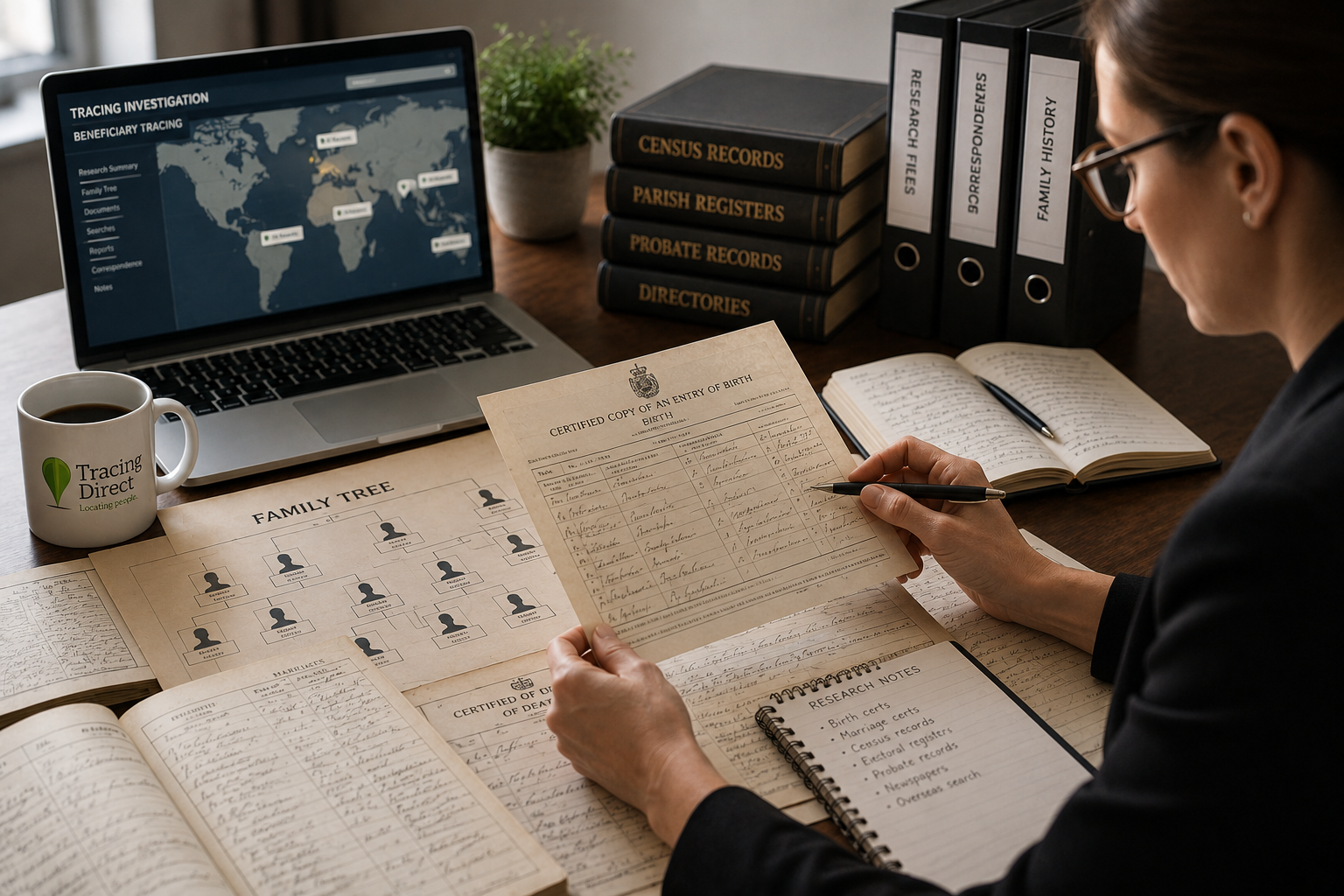
A professional probate researcher reviewing family records and genealogical information as part of a beneficiary tracing investigation for estate administration.
Administering an estate is not always straightforward.
Even where the assets and liabilities of an estate have been established, difficulties identifying or locating beneficiaries can prevent matters from progressing as quickly as everyone would like.
For probate solicitors and executors, beneficiary tracing can therefore become an important part of the estate administration process.
The good news is that many potential delays can be reduced by recognising problems early and obtaining professional probate research assistance when necessary.
Here are 10 common reasons beneficiary tracing can delay probate – and practical ways to minimise those delays.
1. Outdated Contact Information
One of the most common problems is surprisingly simple: the address held for a beneficiary is no longer current.
People move home, change telephone numbers and stop using old email addresses. If there has been little family contact for many years, the information available to an executor may be significantly out of date.
How to avoid delays
Begin attempts to establish current contact details as early as possible.
Where initial enquiries are unsuccessful, instructing a professional beneficiary tracing company can prevent weeks or months being spent pursuing outdated information.
2. Beneficiaries Have Changed Their Name
A beneficiary may no longer use the name by which the deceased or other family members knew them.
Marriage, divorce and other name changes can make an individual significantly more difficult to locate, particularly where the last known information is several decades old.
Professional researchers can use historical and contemporary records to establish links between previous and current identities.
3. Beneficiaries Have Moved Overseas
Modern families are increasingly international.
A relative who once lived in the UK may now be living in Europe, Australia, Canada, the United States or elsewhere in the world.
International beneficiary tracing can be more complex because record availability, privacy rules and registration systems differ between countries.
How to avoid delays
Identify potential overseas connections at the beginning of the investigation rather than treating international research as a last resort.
An experienced probate research company can then determine the most appropriate approach.
4. The Family Tree Is Incomplete
Sometimes the problem isn't locating a known beneficiary.
It's establishing whether other beneficiaries exist at all.
This is particularly important in intestacy matters where entitlement may depend upon establishing different generations and branches of a family.
Half-siblings, previous marriages, deceased relatives and previously unknown descendants can all affect the final family tree.
This is why family tree verification can be just as important as tracing individuals.
5. Information Provided by Relatives Is Incorrect
Family knowledge can provide an excellent starting point for probate research, but memories are not always accurate.
Names may be misspelled, dates remembered incorrectly and family relationships misunderstood.
Information passed between generations can also become distorted over time.
How to avoid delays
Treat family information as a starting point rather than definitive evidence.
Where entitlement depends upon a particular family relationship, documentary verification can provide greater confidence before an estate is distributed.
6. The Search Begins Too Late
A common cause of unnecessary delay is waiting until the estate is almost ready for distribution before addressing beneficiary issues.
If an executor knows from the outset that a beneficiary has not been contacted for 20 years, it makes sense to begin enquiries early.
The same applies where there are obvious gaps in the deceased's family history.
How to avoid delays
Probate solicitors should consider potential tracing requirements during the early stages of estate administration.
Starting research sooner allows tracing work to take place alongside other probate processes rather than becoming an obstacle at the end.
7. Historical Records Need Further Investigation
Some probate cases require research across several generations.
Birth, marriage and death records can provide valuable evidence, but occasionally the information contained within them creates further questions.
Different spellings of surnames, common names, incomplete records and discrepancies between documents can make identification more complicated.
Experienced probate researchers know how to cross-reference multiple sources to establish a reliable chain of evidence.
8. A Beneficiary Has Died
Finding that a beneficiary has died does not necessarily bring the investigation to an end.
Depending upon the circumstances of the estate, further research may be necessary to establish what happens to that person's entitlement and whether additional individuals need to be identified.
This can potentially create an entirely new branch of research.
How to avoid delays
Where a beneficiary is believed to have died, establish the relevant facts as soon as possible and obtain appropriate legal advice regarding the effect on the estate.
9. Trying to Conduct Complex Research Without Specialist Resources
Search engines and social media can sometimes help locate someone.
However, complex beneficiary tracing usually requires considerably more than entering a name into Google or searching Facebook.
Professional probate researchers can draw upon genealogical records, historical sources, specialist databases and investigative techniques that may not be readily available to an executor.
Attempting increasingly complex research without the appropriate resources can consume considerable time without producing reliable evidence.
10. Waiting Too Long to Instruct a Probate Research Specialist
There is nothing wrong with undertaking reasonable initial enquiries.
However, once it becomes clear that a beneficiary cannot easily be found—or that the family structure is more complicated than expected—continuing an unsuccessful search can simply create further delay.
This is where early professional involvement can make a significant difference.
A specialist beneficiary tracing and probate research company can assess the available information, identify the appropriate research strategy and begin working towards establishing the facts.
How Probate Solicitors Can Reduce Beneficiary Tracing Delays
For probate practitioners, one of the most effective approaches is to identify potential beneficiary issues at the beginning of an estate.
Questions worth considering include:
Are the addresses for all beneficiaries current?
Has every beneficiary been contacted?
Are there relatives living overseas?
Are there unexplained gaps in the family tree?
Has the family structure been independently verified where necessary?
Are there beneficiaries who have not been heard from for many years?
Is there uncertainty surrounding any individual's identity or relationship to the deceased?
If concerns arise, early professional probate research can often prevent those issues becoming significant obstacles later.
Why Solicitors Choose Tracing Direct
At Tracing Direct, we understand that probate solicitors need more than someone who can simply search for a name.
They need a professional research partner who understands the importance of accuracy, reliability, confidentiality and communication.
We assist solicitors, executors and other professionals with matters including:
Beneficiary tracing
Missing beneficiary searches
Family tree verification
Probate research
Intestacy investigations
Heir tracing
UK and international research
Our approach is professional and thorough, with a focus on providing clear information that helps our clients progress estate administration efficiently.
We also recognise that cost matters. Our competitive pricing, combined with a reliable and responsive service, allows solicitors to access professional probate research without unnecessary expense.
Don't Let a Missing Beneficiary Become a Last-Minute Problem
Beneficiary tracing does not have to become the reason an estate is unnecessarily delayed.
Identifying potential difficulties early, verifying family information and obtaining specialist assistance when appropriate can make the probate process considerably more manageable.
For solicitors, it can also provide greater confidence that appropriate enquiries have been undertaken before an estate is distributed.
If you have a probate matter involving a missing beneficiary, uncertain family tree or difficult-to-locate heir, speak to Tracing Direct.
Our team can assess the information you already have and explain how we can help move the investigation forward.
The Importance of Family Tree Verification in Probate: Why Accuracy Matters
When administering an estate, one of the most important responsibilities is ensuring that every beneficiary has been correctly identified.
Whether a person has died with a valid Will or under the Rules of Intestacy, distributing an estate to the wrong individual—or overlooking someone who is legally entitled—can have serious legal and financial consequences.
This is why family tree verification plays such a vital role in modern probate. By accurately establishing family relationships and identifying all entitled beneficiaries, probate solicitors can administer estates with confidence while protecting executors from unnecessary risk.
What Is Family Tree Verification?
Family tree verification is the process of researching, confirming and documenting a deceased person's family relationships.
Rather than relying solely on information provided by relatives or personal recollections, professional probate researchers use documentary evidence to establish an accurate family tree.
This may include:
Birth certificates
Marriage certificates
Death certificates
Census records
Electoral registers
Historical parish records
Immigration and emigration records
Probate records
Overseas civil registration documents
Each piece of evidence helps build a complete and verified picture of the deceased's family history.
Why Is Family Tree Verification So Important?
Many estates appear straightforward at first.
However, during probate it is not uncommon to discover:
Unknown relatives.
Children from previous relationships.
Family members who emigrated many years ago.
Beneficiaries who have changed their surname.
Adopted family members.
Half-siblings.
Beneficiaries who have died before the deceased, leaving their own descendants.
Without proper verification, these family connections can easily be overlooked.
Professional family tree verification helps ensure that everyone entitled to inherit has been correctly identified before the estate is distributed.
Protecting Executors from Future Claims
Executors have a legal duty to administer an estate correctly.
If an entitled beneficiary is missed because the family tree was incomplete, the executor could face legal challenges long after the estate has been distributed.
In some cases, executors may even become personally liable for incorrect distributions.
Comprehensive family tree verification provides valuable reassurance that reasonable enquiries have been carried out and that the estate has been administered with appropriate due diligence.
Why Intestacy Cases Require Extra Care
Family tree verification becomes even more important where someone dies without leaving a valid Will.
Under the Rules of Intestacy, inheritance follows a strict legal order based on family relationships.
Determining who is entitled to inherit often requires detailed genealogical research, particularly where the deceased had:
No surviving spouse or civil partner.
No children.
Limited known family.
Relatives living overseas.
Multiple generations of extended family.
A single missing branch of the family can significantly alter how an estate should be distributed.
This makes accurate verification essential before any payments are made.
More Than Simply Finding People
Family tree verification is often confused with beneficiary tracing.
Although closely linked, they perform different functions.
Beneficiary tracing focuses on locating individuals whose whereabouts are unknown.
Family tree verification focuses on confirming that every person who should appear within the family structure has been identified in the first place.
Only once the family tree has been verified can researchers confidently begin tracing beneficiaries whose current whereabouts are unknown.
Together, these services provide solicitors with a complete picture of those entitled to benefit from an estate.
International Family Connections
Today's families are increasingly international.
It is common for beneficiaries to live overseas or for branches of a family to have emigrated decades ago.
Professional probate researchers have access to specialist resources that assist in verifying overseas family relationships and tracing beneficiaries across multiple jurisdictions.
International family tree verification requires careful attention to differing record systems, naming conventions and historical documentation.
Supporting Probate Solicitors
For probate solicitors, accurate family tree verification offers several important benefits:
Greater confidence when advising executors.
Reduced risk of future inheritance claims.
Evidence-based documentation supporting probate files.
More efficient estate administration.
Peace of mind that all reasonable enquiries have been undertaken.
Rather than relying on assumptions or incomplete family information, solicitors can make informed decisions supported by documented research.
Why Choose Tracing Direct?
At Tracing Direct, we understand that accuracy is everything.
Our experienced probate researchers work closely with solicitors, executors and private clients to verify family relationships using reliable documentary evidence and proven genealogical research methods.
Whether the estate involves a straightforward family structure or multiple generations across different countries, we provide clear, professional reporting designed to support efficient estate administration.
Our commitment to accuracy, confidentiality and responsive service has made us a trusted probate research partner for legal professionals throughout the UK.
Conclusion
Family tree verification is far more than an administrative exercise.
It is a vital safeguard that helps ensure estates are distributed correctly, beneficiaries are properly identified and executors are protected from future claims.
For probate solicitors, investing in professional family tree verification provides confidence that every reasonable step has been taken before an estate reaches its conclusion.
If your firm requires expert family tree verification, beneficiary tracing or probate research support, Tracing Direct is here to help.
Our experienced team delivers reliable, evidence-based research that supports accurate estate administration from beginning to end.
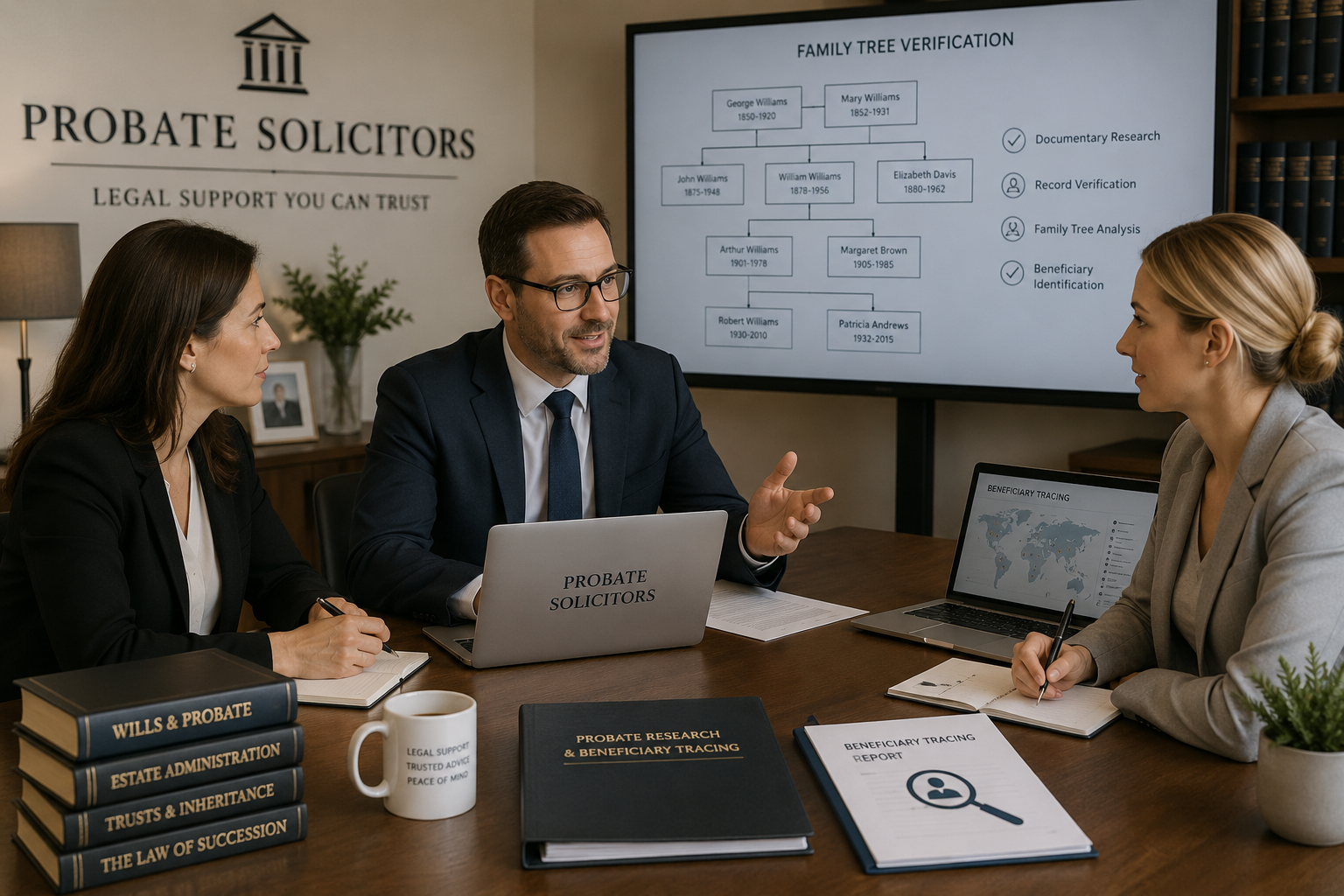
Why Probate Solicitors Choose Tracing Direct for Beneficiary Tracing and Probate Research
When a solicitor is administering an estate, choosing the right probate research partner is about far more than simply locating a missing beneficiary.
It is about working with a company that understands the importance of professionalism, accuracy, confidentiality and delivering results within the timescales expected by clients.
At Tracing Direct, we have built our reputation by providing probate solicitors with reliable beneficiary tracing and probate research services that help estates progress efficiently while protecting executors from unnecessary risk.
A Reputation Built on Professionalism
Every probate matter is unique.
Some involve locating a single missing beneficiary, while others require complex family tree reconstruction, overseas research or identifying heirs under the Rules of Intestacy.
Whatever the circumstances, our approach remains the same.
We provide a professional, discreet and evidence-based service that supports solicitors throughout the estate administration process.
Our clients value clear communication, realistic expectations and honest advice from experienced researchers who understand the importance of every case.
Competitive Pricing Without Compromising Quality
Cost is naturally an important consideration for both solicitors and their clients.
At Tracing Direct, we believe professional probate research should provide excellent value without compromising on quality or accuracy.
Our competitive pricing structure ensures solicitors receive a high-quality service supported by experienced researchers, detailed reporting and responsive communication.
Rather than offering a one-size-fits-all approach, we assess every matter individually to ensure clients receive the most appropriate solution for their particular case.
This means paying for the expertise required—not unnecessary services.
Reliability When It Matters Most
Solicitors need confidence that instructions will be handled efficiently.
Delays in locating beneficiaries or confirming family relationships can slow estate administration, frustrate executors and increase costs.
Reliability is therefore one of the qualities our clients value most.
From the moment we receive instructions, we work proactively to progress investigations and provide regular updates throughout the process.
Our aim is always to help solicitors administer estates as quickly and smoothly as possible.
Experienced Probate Research Specialists
Beneficiary tracing requires far more than searching online databases.
Successful investigations often involve combining genealogy, historical records, public documents, electoral information and specialist investigative research.
Our experienced team understands where to look, how to verify information and how to present findings clearly for probate purposes.
Every investigation is conducted carefully, ensuring evidence is thoroughly checked before conclusions are reached.
Supporting Probate Solicitors Across Every Stage of Estate Administration
Tracing Direct regularly assists solicitors with:
Missing beneficiary tracing
Family tree verification
Intestacy research
Overseas beneficiary searches
Heir identification
Probate genealogy
Estate administration support
Verification of family relationships
Whether dealing with a straightforward estate or a complex international matter, we provide practical support that helps solicitors move matters forward with confidence.
Confidentiality You Can Trust
Probate investigations frequently involve sensitive personal information.
Maintaining confidentiality and handling information responsibly is fundamental to everything we do.
Solicitors can be confident that every instruction is managed professionally and with complete discretion.
Building Long-Term Relationships
Many of our instructions come from returning clients.
We believe this reflects the quality of our work, our responsiveness and our commitment to delivering an excellent client experience.
Rather than simply completing an investigation, we aim to become a trusted extension of the solicitor's team—providing dependable probate research whenever it is needed.
Why Choose Tracing Direct?
Choosing a probate research partner is ultimately about trust.
Solicitors need confidence that investigations will be handled professionally, beneficiaries will be traced efficiently and communication will remain clear throughout every stage of the matter.
Tracing Direct combines:
Professional and experienced researchers
Competitive pricing
Reliable turnaround times
Accurate family tree verification
UK and international beneficiary tracing
Responsive communication
Confidential and discreet investigations
A commitment to exceptional client service
These qualities have helped establish Tracing Direct as a trusted probate research partner for solicitors, executors, local authorities and private clients throughout the UK.
Contact Tracing Direct
If your firm requires professional beneficiary tracing, probate genealogy or estate administration support, our experienced team is ready to help.
Contact Tracing Direct today to discuss your requirements and discover why so many probate professionals rely on our expertise.

Missing Beneficiaries in Probate: What Solicitors Need to Know
When administering an estate, few situations create more uncertainty than discovering that a beneficiary cannot be located.
Whether the beneficiary moved abroad years ago, changed their name following marriage, emigrated, or simply lost contact with the family, locating them becomes an essential part of the probate process.
For probate solicitors, failing to identify or locate the correct beneficiary can expose executors to significant legal and financial risks. Professional beneficiary tracing ensures estates are administered efficiently while protecting everyone involved.
Why Do Beneficiaries Go Missing?
Missing beneficiaries are more common than many people realise.
Solicitors frequently encounter situations where:
Family members have emigrated overseas.
Contact details are decades out of date.
Relationships have broken down.
Beneficiaries have changed their surname.
There are limited family records available.
The deceased had little contact with extended relatives.
Modern families are increasingly spread across different countries, making searches considerably more challenging than they once were.
The Risks of Distributing an Estate Too Early
Executors have a legal duty to distribute an estate correctly.
Making distributions before every beneficiary has been identified can result in:
Claims against the executor.
Personal financial liability.
Costly legal disputes.
Delays in closing the estate.
Reputational risk for solicitors.
For this reason, probate practitioners often seek specialist assistance before making final distributions.
When Should a Solicitor Instruct a Beneficiary Tracing Company?
Professional tracing is often appropriate when:
A beneficiary cannot be contacted
Letters are returned, telephone numbers no longer work or no recent address can be found.
Family information is incomplete
The deceased's family tree contains missing branches or uncertain relationships.
Beneficiaries may live overseas
International tracing often requires specialist resources and local knowledge.
There are concerns about unidentified heirs
Where someone has died intestate, identifying every entitled beneficiary is critical before distribution.
Estates involve significant assets
Higher-value estates justify comprehensive due diligence to reduce future risk.
How Professional Beneficiary Tracing Helps
A specialist probate research company combines genealogy, investigative research and access to specialist databases to locate beneficiaries quickly and accurately.
This typically includes:
Comprehensive family tree verification
UK and international tracing
Verification of identity
Address confirmation
Documentary evidence supporting the search
Detailed reports suitable for probate files
Professional tracing provides solicitors with confidence that reasonable enquiries have been undertaken before distributing the estate.
The Importance of Accurate Family Tree Verification
Locating a beneficiary is only part of the process.
Equally important is confirming that every beneficiary entitled under the Will—or under the Rules of Intestacy—has been identified correctly.
Professional probate researchers verify family relationships using birth, marriage and death records alongside historical archives and genealogical research.
This helps prevent incorrect distributions and protects executors from future claims.
International Beneficiary Searches
Modern probate frequently involves beneficiaries living overseas.
Professional tracing companies regularly locate beneficiaries across Europe, North America, Australia, New Zealand and many other jurisdictions.
International searches often require knowledge of overseas records, electoral information and local documentation that is not easily accessible through standard public searches.
Why Solicitors Choose Tracing Direct
At Tracing Direct, we work alongside probate solicitors, executors, local authorities and private clients to provide discreet, accurate and efficient beneficiary tracing services.
Our experienced researchers understand the importance of speed, accuracy and confidentiality throughout the probate process.
Whether locating a single missing beneficiary or verifying an extensive family tree, we provide clear evidence-based reporting that supports estate administration from beginning to end.
Need Help Locating a Missing Beneficiary?
If you're administering an estate and need assistance locating missing beneficiaries or verifying family relationships, the team at Tracing Direct can help.
Our specialist beneficiary tracing and probate research services help solicitors minimise delays, reduce risk and administer estates with confidence.
Contact Tracing Direct today to discuss your requirements.
When Should a Solicitor Instruct a Beneficiary Tracing Company?
Written by Jamie Aherne
For probate solicitors, administering an estate efficiently depends on having accurate information and confidence that every beneficiary has been identified.
While many estates progress without complication, others present challenges that require specialist expertise. Missing beneficiaries, incomplete family information, overseas relatives or intestacy can all delay the administration of an estate and increase the risk of future claims.
Knowing when to instruct a professional beneficiary tracing company can save valuable time, reduce risk and demonstrate that appropriate due diligence has been undertaken.
Why Beneficiary Tracing Matters
Solicitors have a duty to administer estates correctly and ensure that those legally entitled to inherit receive their inheritance.
Where a beneficiary cannot be located, or there is uncertainty surrounding family relationships, distributing an estate without carrying out appropriate enquiries can expose executors and personal representatives to unnecessary legal and financial risks.
Professional beneficiary tracing provides documented evidence that reasonable steps have been taken to identify and locate all entitled beneficiaries.
Situations Where Solicitors Should Consider Beneficiary Tracing
A Beneficiary Cannot Be Located
One of the most common reasons for instructing a beneficiary tracing specialist is when a beneficiary has lost contact with the family.
This may happen because they have:
Changed their surname.
Moved without leaving a forwarding address.
Emigrated overseas.
Become estranged from relatives.
Passed away, leaving their own successors.
Professional tracing combines genealogical research with modern investigative techniques to locate individuals both within the UK and internationally.
The Estate Is Being Administered Under Intestacy
Where someone dies without leaving a valid Will, the Rules of Intestacy determine who is legally entitled to inherit.
This often requires a complete family tree to be established before the estate can be distributed.
Professional probate researchers can identify:
Unknown relatives.
Previously undiscovered branches of the family.
Overseas beneficiaries.
Correct entitlement under intestacy legislation.
This helps ensure the estate is distributed accurately and lawfully.
Family Relationships Need Verifying
Even where beneficiaries are known, solicitors may need documentary evidence confirming family relationships.
This is particularly important where there are:
Multiple marriages.
Adoptions.
Name changes.
Blended families.
Missing historical records.
Professional family tree verification provides clear evidence to support the administration of the estate.
Overseas Beneficiaries Are Involved
International estates often introduce additional complexity.
Tracing beneficiaries across different jurisdictions requires specialist knowledge of international records, electoral registers, genealogy databases and local research resources.
An experienced tracing company can significantly reduce the time involved in locating overseas heirs.
Reducing Risk for Executors
Executors have legal responsibilities throughout the probate process.
Distributing an estate before all beneficiaries have been identified could expose them to personal liability should additional beneficiaries later come forward.
Obtaining professional probate research demonstrates that reasonable enquiries have been undertaken, providing reassurance for both solicitors and executors.
Why Solicitors Choose Professional Probate Researchers
Partnering with an experienced probate research company allows solicitors to:
Save valuable fee-earner time.
Reduce delays in estate administration.
Access specialist genealogical expertise.
Obtain documented evidence supporting due diligence.
Minimise the risk of future inheritance claims.
Improve the overall client experience.
Rather than spending hours researching family history, solicitors can focus on progressing the legal aspects of the estate.
How Tracing Direct Supports Probate Solicitors
At Tracing Direct, we work alongside probate solicitors, private client departments, executors and estate administrators throughout the UK.
Our specialist services include:
Beneficiary Tracing
Probate Research
Family Tree Verification
Missing Beneficiary Searches
International Heir Tracing
Intestacy Research
Every instruction is handled with professionalism, discretion and meticulous attention to detail.
Our experienced researchers combine genealogical expertise with detailed documentary investigation, delivering evidence-based research that helps solicitors administer estates efficiently and confidently.
Looking for a Trusted Probate Research Partner?
If you're a probate solicitor dealing with missing beneficiaries, complex family structures or intestate estates, Tracing Direct can help.
Our experienced team provides reliable beneficiary tracing and probate research services across the UK and internationally, helping legal professionals reduce risk, save time and administer estates with confidence.
Contact Tracing Direct today to discuss how we can support your next instruction.

What Are the Responsibilities of an Executor During Probate?

Being appointed as the executor of a Will is often seen as an honour. It means the person who has passed away trusted you to carry out their final wishes and administer their estate correctly.
However, many executors quickly discover that the role involves far more responsibility than they expected.
From locating beneficiaries to managing assets and ensuring legal compliance, administering an estate can be both time-consuming and complex. Understanding your responsibilities from the outset can help make the probate process smoother and reduce the risk of costly mistakes.
What Is an Executor?
An executor is the person (or people) named in a Will who is legally responsible for administering the deceased's estate.
Their duties begin after the person's death and continue until every asset has been collected, debts settled and the estate distributed to the rightful beneficiaries.
Executors have a legal duty to act in the best interests of the estate and its beneficiaries throughout the process.
The Main Responsibilities of an Executor
Although every estate is different, the role of an executor typically includes several key responsibilities.
Registering the Death
The first step is ensuring the death has been officially registered and obtaining multiple certified copies of the death certificate, as these will be required by banks, financial institutions and government departments.
Locating the Will
Executors must locate the most recent valid Will.
This document identifies the beneficiaries and outlines how the estate should be distributed.
If no valid Will exists, the estate will instead be administered under the Rules of Intestacy.
Valuing the Estate
Before probate can be granted, executors need to identify and value all assets and liabilities.
This may include:
Property
Bank accounts
Investments
Pensions
Personal possessions
Outstanding debts
Obtaining accurate valuations is essential for probate and inheritance tax purposes.
Applying for Probate
In many cases, executors must apply for a Grant of Probate before they have authority to deal with the estate.
This legal document allows them to collect assets, close accounts and administer the estate according to the Will.
Paying Debts and Taxes
Before beneficiaries receive their inheritance, executors must ensure that:
Outstanding debts are settled.
Funeral expenses are paid.
Inheritance Tax (where applicable) is accounted for.
Any outstanding Income Tax or Capital Gains Tax matters are resolved.
Only once these obligations have been met should the estate be distributed.
What Happens if Beneficiaries Cannot Be Found?
One challenge that executors sometimes face is discovering that a beneficiary cannot be located.
Perhaps they have:
Changed their name.
Moved overseas.
Lost contact with the family.
Passed away themselves.
Executors have a duty to make reasonable efforts to locate anyone entitled to inherit.
Professional beneficiary tracing services can help identify and locate missing beneficiaries while providing evidence that appropriate due diligence has been undertaken.
Why Accurate Family Research Is Important
Even where beneficiaries are known, family relationships sometimes require verification.
Professional probate research may be needed to:
Confirm family connections.
Build accurate family trees.
Identify additional entitled relatives.
Support estates administered under Intestacy.
This research helps protect executors from distributing an estate incorrectly.
Can an Executor Be Personally Liable?
Yes.
Executors have legal responsibilities and, in some circumstances, can become personally liable if mistakes are made.
Examples include:
Distributing an estate before all beneficiaries have been identified.
Paying beneficiaries before settling debts.
Failing to account for inheritance tax correctly.
Not carrying out sufficient enquiries into family entitlement.
Seeking professional advice where appropriate can significantly reduce these risks.
When Should an Executor Seek Professional Help?
Many estates are straightforward.
Others involve:
Missing beneficiaries.
Overseas relatives.
Complex family structures.
Unclear Wills.
Intestacy.
High-value estates.
Professional probate researchers and beneficiary tracing specialists can provide valuable assistance, helping executors administer estates accurately and efficiently.
How Tracing Direct Supports Executors
At Tracing Direct, we work closely with executors, solicitors, local authorities and private families across the UK and internationally.
Our specialist services include:
Beneficiary tracing
Probate research
Family tree verification
Missing heir searches
International heir tracing
Our experienced researchers combine genealogical expertise with detailed documentary investigation, providing accurate, evidence-based research that supports the probate process and gives executors confidence that estates are administered correctly.
Need Help Administering an Estate?
If you're an executor and need assistance locating beneficiaries, verifying family relationships or carrying out probate research, Tracing Direct is here to help.
Our experienced team provides trusted probate research and beneficiary tracing services throughout the UK and worldwide, helping executors administer estates with confidence.
Probate Research Explained: Why Family Trees Matter More Than You Might Think
When most people think about probate, they picture solicitors, Wills and estate administration. Few realise that behind many estates lies a detailed investigation into family history.
This process, known as probate research, plays a vital role in ensuring estates are distributed correctly and that the right people inherit.
Whether there is a valid Will or the estate is being administered under the Rules of Intestacy, establishing the correct family relationships is often one of the most important parts of the probate process.
What Is Probate Research?
Probate research is the process of investigating a deceased person's family history to establish who is legally entitled to inherit from an estate.
The research may involve:
Building accurate family trees.
Confirming births, marriages and deaths.
Identifying surviving relatives.
Verifying relationships between family members.
Locating missing heirs.
Confirming whether a family line has become extinct.
The objective is simple: ensure the estate is distributed to the correct beneficiaries.
Why Isn't a Family Tree Always Straightforward?
Many people assume tracing a family tree simply involves looking up a few names online.
In reality, family histories can become incredibly complex.
Probate researchers regularly encounter situations such as:
Multiple marriages.
Children from different relationships.
Adoptions.
Name changes.
Relatives who emigrated decades ago.
Families spread across several continents.
Missing or incomplete historical records.
Every generation adds another layer of complexity, particularly when researching families over 100 years.
When Is Probate Research Needed?
Probate research may be required in a wide range of situations.
There Is No Valid Will
When someone dies intestate, the estate must be distributed according to the Rules of Intestacy.
This means identifying every surviving relative who may have a legal entitlement to inherit.
The Will Is Unclear
Sometimes a Will names beneficiaries with limited information such as:
"My cousin John"
"My niece Sarah"
"The children of my late brother"
Additional research may be required to establish exactly who those individuals are.
Family Relationships Need Verification
Even where beneficiaries are known, executors may require documentary evidence confirming family relationships before distributing the estate.
Why Accuracy Matters
Probate research is not simply about finding people.
It is about ensuring legal accuracy.
An incorrect assumption about a family relationship could result in:
Incorrect estate distribution.
Delays in administration.
Legal disputes.
Financial liability for executors.
For this reason, professional probate researchers carefully verify every family connection using official records and supporting evidence.
International Families Are Becoming Increasingly Common
Modern families are more geographically dispersed than ever before.
It is increasingly common for probate researchers to investigate relatives living in:
Australia
Canada
New Zealand
South Africa
Europe
The United States
International probate research often involves navigating different record systems, languages and legal jurisdictions, making specialist experience invaluable.
The Value of Independent Probate Research
Professional probate research provides confidence that the correct beneficiaries have been identified before an estate is distributed.
For solicitors, executors and local authorities, independent research can provide:
Evidence-based family trees.
Verification of legal entitlement.
Reduced risk of future claims.
Greater confidence when administering estates.
A clear audit trail supporting probate decisions.
Ultimately, accurate research protects both the estate and those responsible for administering it.
How Tracing Direct Supports Probate Professionals
At Tracing Direct, we specialise in professional probate research for solicitors, executors, local authorities and private clients throughout the UK and internationally.
Our experienced researchers combine genealogical expertise with detailed documentary research to establish family relationships accurately and efficiently.
Whether we're confirming a single family connection or reconstructing multiple generations of a complex family tree, our focus is always the same: providing reliable research that helps estates be administered correctly and with confidence.
Need professional probate research?
If you're administering an estate and need to verify family relationships, establish entitlement or build an accurate family tree, the team at Tracing Direct is here to help. Our trusted probate research services support clients across the UK and around the world, providing clear, evidence-based results you can rely on.
What Happens If A Beneficiary Cannot Be Found During Probate?
When administering an estate, one of the most common challenges faced by solicitors, executors and estate administrators is dealing with a missing beneficiary.
Whether the individual has moved address, lost contact with family members or emigrated overseas, locating entitled beneficiaries is often an essential part of the probate process.
But what happens when a beneficiary cannot be found?
Why Beneficiaries Go Missing
There are many reasons why a beneficiary may become difficult to locate.
Common examples include:
Family members losing contact over time
Relocation within the UK
Emigration overseas
Changes of name through marriage or other circumstances
Limited information within estate records
Complex family structures spanning multiple generations
In some cases, the deceased may have maintained little contact with wider family members for many years, making identification and location more challenging.
Why Finding Beneficiaries Matters
Before an estate can be fully distributed, those entitled to inherit generally need to be identified and, where possible, contacted.
Failure to identify beneficiaries can create uncertainty and delay estate administration.
For solicitors and executors, ensuring reasonable steps have been taken to locate beneficiaries is an important part of the administration process.
How Missing Beneficiaries Are Traced
Professional beneficiary tracing involves a combination of:
Probate research
Family tree verification
Genealogical investigation
Address tracing
Documentary record analysis
International research where required
The objective is to identify, locate and verify beneficiaries whilst establishing their relationship to the deceased.
What If The Beneficiary Lives Overseas?
Modern families are increasingly international.
It is common for beneficiaries to be located in:
Europe
North America
Australia
New Zealand
Other international jurisdictions
International heir tracing may be required to identify and locate family members living abroad.
In these circumstances, professional probate researchers can often assist with locating overseas beneficiaries and verifying family connections.
Family Tree Verification
Locating a beneficiary is only part of the process.
It is also important to establish how that individual is connected to the deceased and whether they are entitled to inherit.
Family tree verification may involve reviewing:
Birth records
Marriage records
Death records
Probate records
Census information
Historical family documentation
This helps create a clear and evidence-based picture of the family structure.
How Professional Probate Research Can Help
Professional probate researchers regularly assist with:
Missing beneficiary searches
Beneficiary tracing
Family tree verification
Intestacy research
International heir tracing
Probate research
This support helps solicitors, executors and estate administrators progress matters more efficiently and with greater confidence.
Reducing Delays In Estate Administration
One of the biggest risks associated with missing beneficiaries is delay.
Where entitled beneficiaries cannot be identified or located, estate administration can become more complex and time-consuming.
Early beneficiary tracing and family verification can often help reduce delays and provide clearer evidence for decision-making.
How Tracing Direct Can Help
Tracing Direct has supported solicitors, executors, estate administrators and beneficiaries with professional probate research services for more than 20 years.
Our services include:
Beneficiary Tracing
Missing Beneficiary Searches
Probate Research
Family Tree Verification
International Heir Tracing
We provide confidential, professional and evidence-based research support throughout the UK and internationally.
Need Assistance Locating A Beneficiary?
If you require assistance locating a missing beneficiary, verifying family relationships or supporting estate administration, our experienced team is here to help.
Call: 0800 0431 793
Email: info@tracingdirect.co.uk
Tracing Direct — supporting legal professionals and beneficiaries through careful research, professional integrity and proven expertise.