

What Are the Responsibilities of an Executor During Probate?

Being appointed as the executor of a Will is often seen as an honour. It means the person who has passed away trusted you to carry out their final wishes and administer their estate correctly.
However, many executors quickly discover that the role involves far more responsibility than they expected.
From locating beneficiaries to managing assets and ensuring legal compliance, administering an estate can be both time-consuming and complex. Understanding your responsibilities from the outset can help make the probate process smoother and reduce the risk of costly mistakes.
What Is an Executor?
An executor is the person (or people) named in a Will who is legally responsible for administering the deceased's estate.
Their duties begin after the person's death and continue until every asset has been collected, debts settled and the estate distributed to the rightful beneficiaries.
Executors have a legal duty to act in the best interests of the estate and its beneficiaries throughout the process.
The Main Responsibilities of an Executor
Although every estate is different, the role of an executor typically includes several key responsibilities.
Registering the Death
The first step is ensuring the death has been officially registered and obtaining multiple certified copies of the death certificate, as these will be required by banks, financial institutions and government departments.
Locating the Will
Executors must locate the most recent valid Will.
This document identifies the beneficiaries and outlines how the estate should be distributed.
If no valid Will exists, the estate will instead be administered under the Rules of Intestacy.
Valuing the Estate
Before probate can be granted, executors need to identify and value all assets and liabilities.
This may include:
Property
Bank accounts
Investments
Pensions
Personal possessions
Outstanding debts
Obtaining accurate valuations is essential for probate and inheritance tax purposes.
Applying for Probate
In many cases, executors must apply for a Grant of Probate before they have authority to deal with the estate.
This legal document allows them to collect assets, close accounts and administer the estate according to the Will.
Paying Debts and Taxes
Before beneficiaries receive their inheritance, executors must ensure that:
Outstanding debts are settled.
Funeral expenses are paid.
Inheritance Tax (where applicable) is accounted for.
Any outstanding Income Tax or Capital Gains Tax matters are resolved.
Only once these obligations have been met should the estate be distributed.
What Happens if Beneficiaries Cannot Be Found?
One challenge that executors sometimes face is discovering that a beneficiary cannot be located.
Perhaps they have:
Changed their name.
Moved overseas.
Lost contact with the family.
Passed away themselves.
Executors have a duty to make reasonable efforts to locate anyone entitled to inherit.
Professional beneficiary tracing services can help identify and locate missing beneficiaries while providing evidence that appropriate due diligence has been undertaken.
Why Accurate Family Research Is Important
Even where beneficiaries are known, family relationships sometimes require verification.
Professional probate research may be needed to:
Confirm family connections.
Build accurate family trees.
Identify additional entitled relatives.
Support estates administered under Intestacy.
This research helps protect executors from distributing an estate incorrectly.
Can an Executor Be Personally Liable?
Yes.
Executors have legal responsibilities and, in some circumstances, can become personally liable if mistakes are made.
Examples include:
Distributing an estate before all beneficiaries have been identified.
Paying beneficiaries before settling debts.
Failing to account for inheritance tax correctly.
Not carrying out sufficient enquiries into family entitlement.
Seeking professional advice where appropriate can significantly reduce these risks.
When Should an Executor Seek Professional Help?
Many estates are straightforward.
Others involve:
Missing beneficiaries.
Overseas relatives.
Complex family structures.
Unclear Wills.
Intestacy.
High-value estates.
Professional probate researchers and beneficiary tracing specialists can provide valuable assistance, helping executors administer estates accurately and efficiently.
How Tracing Direct Supports Executors
At Tracing Direct, we work closely with executors, solicitors, local authorities and private families across the UK and internationally.
Our specialist services include:
Beneficiary tracing
Probate research
Family tree verification
Missing heir searches
International heir tracing
Our experienced researchers combine genealogical expertise with detailed documentary investigation, providing accurate, evidence-based research that supports the probate process and gives executors confidence that estates are administered correctly.
Need Help Administering an Estate?
If you're an executor and need assistance locating beneficiaries, verifying family relationships or carrying out probate research, Tracing Direct is here to help.
Our experienced team provides trusted probate research and beneficiary tracing services throughout the UK and worldwide, helping executors administer estates with confidence.

Probate Research Explained: Why Family Trees Matter More Than You Might Think
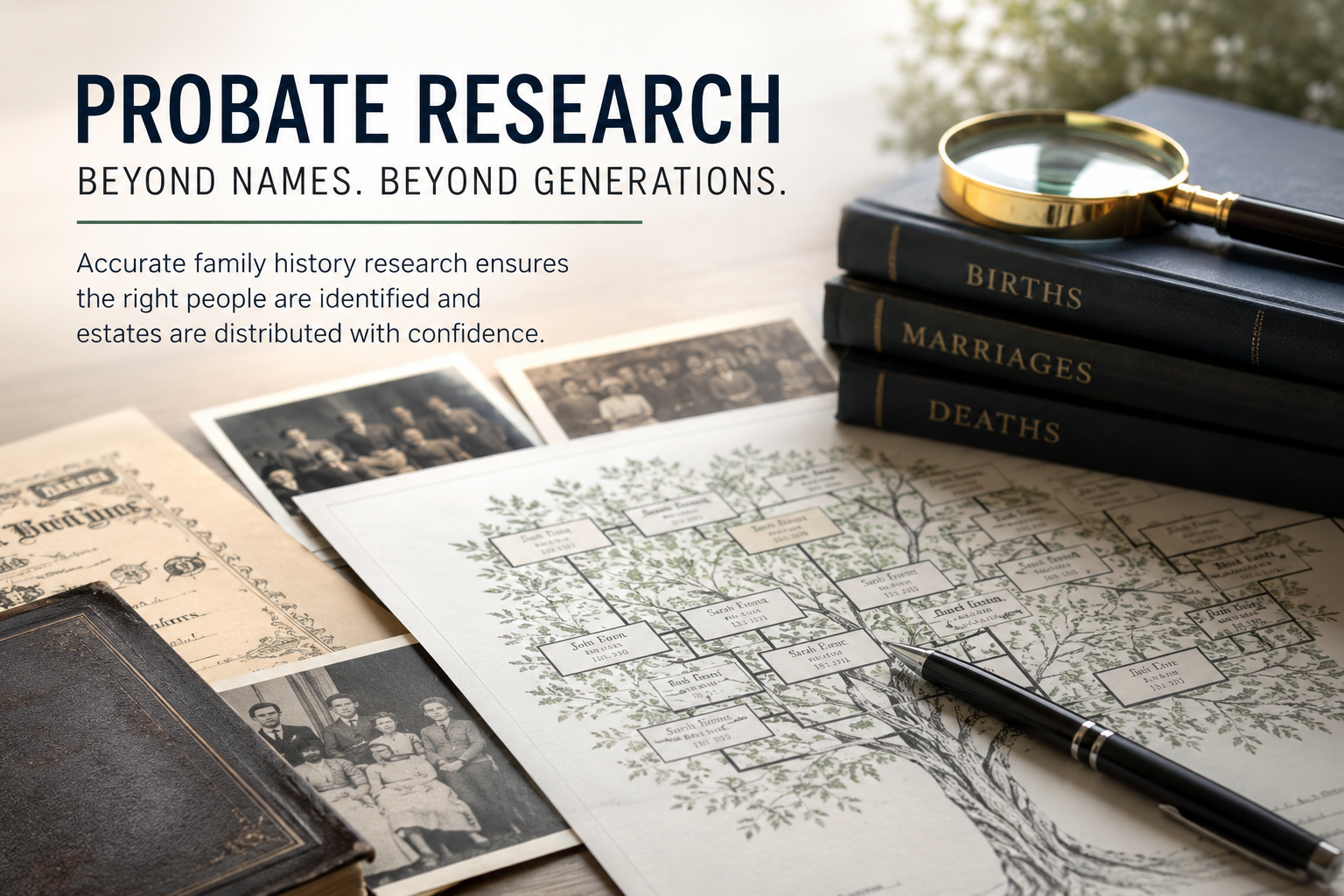
When most people think about probate, they picture solicitors, Wills and estate administration. Few realise that behind many estates lies a detailed investigation into family history.
This process, known as probate research, plays a vital role in ensuring estates are distributed correctly and that the right people inherit.
Whether there is a valid Will or the estate is being administered under the Rules of Intestacy, establishing the correct family relationships is often one of the most important parts of the probate process.
What Is Probate Research?
Probate research is the process of investigating a deceased person's family history to establish who is legally entitled to inherit from an estate.
The research may involve:
Building accurate family trees.
Confirming births, marriages and deaths.
Identifying surviving relatives.
Verifying relationships between family members.
Locating missing heirs.
Confirming whether a family line has become extinct.
The objective is simple: ensure the estate is distributed to the correct beneficiaries.
Why Isn't a Family Tree Always Straightforward?
Many people assume tracing a family tree simply involves looking up a few names online.
In reality, family histories can become incredibly complex.
Probate researchers regularly encounter situations such as:
Multiple marriages.
Children from different relationships.
Adoptions.
Name changes.
Relatives who emigrated decades ago.
Families spread across several continents.
Missing or incomplete historical records.
Every generation adds another layer of complexity, particularly when researching families over 100 years.
When Is Probate Research Needed?
Probate research may be required in a wide range of situations.
There Is No Valid Will
When someone dies intestate, the estate must be distributed according to the Rules of Intestacy.
This means identifying every surviving relative who may have a legal entitlement to inherit.
The Will Is Unclear
Sometimes a Will names beneficiaries with limited information such as:
"My cousin John"
"My niece Sarah"
"The children of my late brother"
Additional research may be required to establish exactly who those individuals are.
Family Relationships Need Verification
Even where beneficiaries are known, executors may require documentary evidence confirming family relationships before distributing the estate.
Why Accuracy Matters
Probate research is not simply about finding people.
It is about ensuring legal accuracy.
An incorrect assumption about a family relationship could result in:
Incorrect estate distribution.
Delays in administration.
Legal disputes.
Financial liability for executors.
For this reason, professional probate researchers carefully verify every family connection using official records and supporting evidence.
International Families Are Becoming Increasingly Common
Modern families are more geographically dispersed than ever before.
It is increasingly common for probate researchers to investigate relatives living in:
Australia
Canada
New Zealand
South Africa
Europe
The United States
International probate research often involves navigating different record systems, languages and legal jurisdictions, making specialist experience invaluable.
The Value of Independent Probate Research
Professional probate research provides confidence that the correct beneficiaries have been identified before an estate is distributed.
For solicitors, executors and local authorities, independent research can provide:
Evidence-based family trees.
Verification of legal entitlement.
Reduced risk of future claims.
Greater confidence when administering estates.
A clear audit trail supporting probate decisions.
Ultimately, accurate research protects both the estate and those responsible for administering it.
How Tracing Direct Supports Probate Professionals
At Tracing Direct, we specialise in professional probate research for solicitors, executors, local authorities and private clients throughout the UK and internationally.
Our experienced researchers combine genealogical expertise with detailed documentary research to establish family relationships accurately and efficiently.
Whether we're confirming a single family connection or reconstructing multiple generations of a complex family tree, our focus is always the same: providing reliable research that helps estates be administered correctly and with confidence.
Need professional probate research?
If you're administering an estate and need to verify family relationships, establish entitlement or build an accurate family tree, the team at Tracing Direct is here to help. Our trusted probate research services support clients across the UK and around the world, providing clear, evidence-based results you can rely on.

What Happens If A Beneficiary Cannot Be Found During Probate?
When administering an estate, one of the most common challenges faced by solicitors, executors and estate administrators is dealing with a missing beneficiary.
Whether the individual has moved address, lost contact with family members or emigrated overseas, locating entitled beneficiaries is often an essential part of the probate process.
But what happens when a beneficiary cannot be found?
Why Beneficiaries Go Missing
There are many reasons why a beneficiary may become difficult to locate.
Common examples include:
Family members losing contact over time
Relocation within the UK
Emigration overseas
Changes of name through marriage or other circumstances
Limited information within estate records
Complex family structures spanning multiple generations
In some cases, the deceased may have maintained little contact with wider family members for many years, making identification and location more challenging.
Why Finding Beneficiaries Matters
Before an estate can be fully distributed, those entitled to inherit generally need to be identified and, where possible, contacted.
Failure to identify beneficiaries can create uncertainty and delay estate administration.
For solicitors and executors, ensuring reasonable steps have been taken to locate beneficiaries is an important part of the administration process.
How Missing Beneficiaries Are Traced
Professional beneficiary tracing involves a combination of:
Probate research
Family tree verification
Genealogical investigation
Address tracing
Documentary record analysis
International research where required
The objective is to identify, locate and verify beneficiaries whilst establishing their relationship to the deceased.
What If The Beneficiary Lives Overseas?
Modern families are increasingly international.
It is common for beneficiaries to be located in:
Europe
North America
Australia
New Zealand
Other international jurisdictions
International heir tracing may be required to identify and locate family members living abroad.
In these circumstances, professional probate researchers can often assist with locating overseas beneficiaries and verifying family connections.
Family Tree Verification
Locating a beneficiary is only part of the process.
It is also important to establish how that individual is connected to the deceased and whether they are entitled to inherit.
Family tree verification may involve reviewing:
Birth records
Marriage records
Death records
Probate records
Census information
Historical family documentation
This helps create a clear and evidence-based picture of the family structure.
How Professional Probate Research Can Help
Professional probate researchers regularly assist with:
Missing beneficiary searches
Beneficiary tracing
Family tree verification
Intestacy research
International heir tracing
Probate research
This support helps solicitors, executors and estate administrators progress matters more efficiently and with greater confidence.
Reducing Delays In Estate Administration
One of the biggest risks associated with missing beneficiaries is delay.
Where entitled beneficiaries cannot be identified or located, estate administration can become more complex and time-consuming.
Early beneficiary tracing and family verification can often help reduce delays and provide clearer evidence for decision-making.
How Tracing Direct Can Help
Tracing Direct has supported solicitors, executors, estate administrators and beneficiaries with professional probate research services for more than 20 years.
Our services include:
Beneficiary Tracing
Missing Beneficiary Searches
Probate Research
Family Tree Verification
International Heir Tracing
We provide confidential, professional and evidence-based research support throughout the UK and internationally.
Need Assistance Locating A Beneficiary?
If you require assistance locating a missing beneficiary, verifying family relationships or supporting estate administration, our experienced team is here to help.
Call: 0800 0431 793
Email: info@tracingdirect.co.uk
Tracing Direct — supporting legal professionals and beneficiaries through careful research, professional integrity and proven expertise.